
|
|
|
Detailed Answers for Test 1 |
|
Question 1 |
|
This Question Does not have a Detailed Solution |
|
|
|
Question 2 |
|
This Question Does not have a Detailed Solution |
|
|
|
Question 3 |
|
Information gathering would be one of the key competencies you should consider in this case. As a police officer you will often be required to take some initiative as well, and detectives will often appreciate this. Ignoring the detective's order is obviously incorrect. |
|
|
|
Question 4 |
|
Before taking a major step in an investigation, it would be a good idea to speak to the officer in charge. Organizational awareness would be the key competency to be aware of here. |
|
|
|
Question 5 |
|
Organizational awareness would come into play here. Disregarding the detective's order to perform a photo line-up is inappropriate. Although you could hand the investigation over to the detective's office, working as a police officer requires teamwork. Continuing to assist in the investigation is the best choice. |
|
|
|
Question 6 |
|
The first priority is protection of life. A crime has also been alleged and there is evidence that the male is telling the truth. The female would need to be arrested. |
|
|
|
Question 7 |
|
Concern for safety and information gathering would be competencies to consider in this situation. A house fire could pose a serious threat to life and the unusual situation should be investigated. Ignoring the situation would be the last choice to make. |
|
|
|
Question 8 |
|
Safety of the people in the bank and yourself is the most important concern as a police officer. Attempting to prevent the robbery could pose an incredible danger, especially while you are off duty. Action must be taken however, and as a professional police officer, you should be attaining the best descriptions possible. |
|
|
|
Question 9 |
|
All of the other scenarios are describing crimes in process or events that may place people's lives in danger. This event has already transpired and the situation is under control. You just have to go in and process the paperwork. |
|
|
|
Question 10 |
|
Confronting Bill or talking to co-workers claiming Bill may be the thief would be negative responses and cause problems with moral, but making a criminal allegation without evidence or proof to support your claim will also cause the same problems and may also lead to issues with your own career. At this stage, doing nothing is the best option. |
|
|
|
Question 11 |
|
Confronting Bill or talking to co-workers claiming Bill may be the thief would be negative responses and cause problems with moral, but making a criminal allegation without evidence or proof to support your claim will also cause the same problems and may also lead to issues with your own career. |
|
|
|
Question 12 |
|
Discontinuing CPR shouldn't occur. Getting John away from the danger is extremely important. Offering to relieve him takes care of both issues. Simply getting gloves fails to alert John to the danger he is facing. |
|
|
|
Question 13 |
|
You have to attempt to continue saving the victim's life. Simply discontinuing CPR would be the worst course of action. All other options attempt to continue saving the victim's life, while in some way addressing the safety issues. John should be notified immediately about the danger though. |
|
|
|
Question 14 |
|
Of the four accounts, the correct answer shares more in common with the other three statements. There are no statements that are not confirmed by other witnesses. |
|
|
|
Question 15 |
|
Of the four accounts, the correct answer shares more in common with the other three statements. There are no statements that are not confirmed by other witnesses. |
|
|
|
Question 16 |
|
Of the four accounts, the correct answer shares more in common with the other three statements. There are no statements that are not confirmed by other witnesses. |
|
|
|
Question 17 |
|
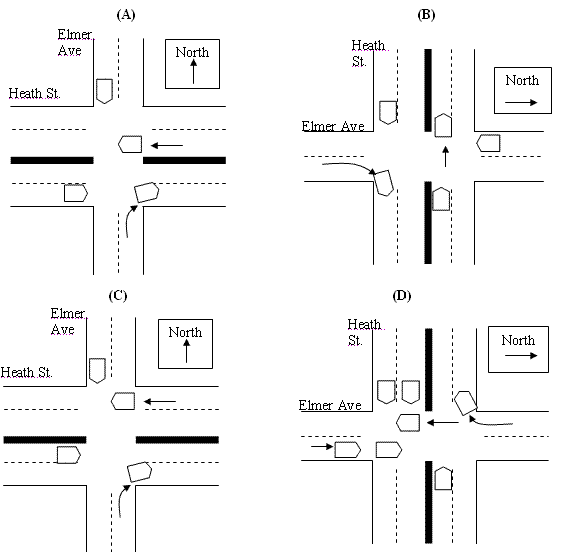
ANS: A – Answer B is not the best answer because there are actually five cars in the diagram, while only four are mentioned in the scenario. Option C is incorrect because the vehicle travelling westbound would be in the wrong lane (outside/curb lane) and the vehicle stopped on Heath Street would also be in the wrong lane (inside/centre lane). Option D also contains too many vehicles and fails to match the description of the scenario on several levels. Option A is the best choice. |
|
 |
|
Question 18 |
|
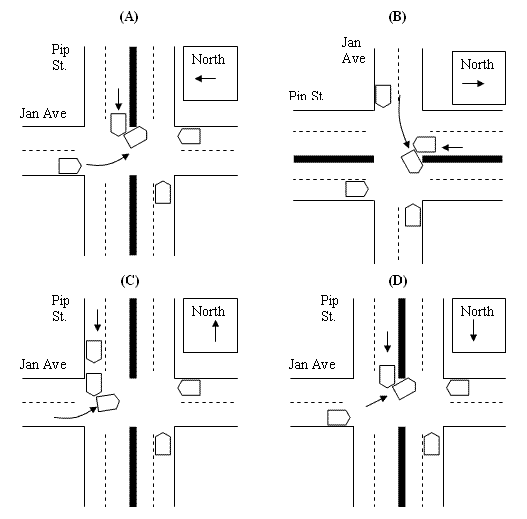
ANS: A – Options B and C are incorrect as the accidents in these cases would be in the northwest corner of the intersection. Option D is incorrect as the accident takes place in the southeast corner of the intersection. Option A is the best answer. |
|
 |
|
Question 19 |
|
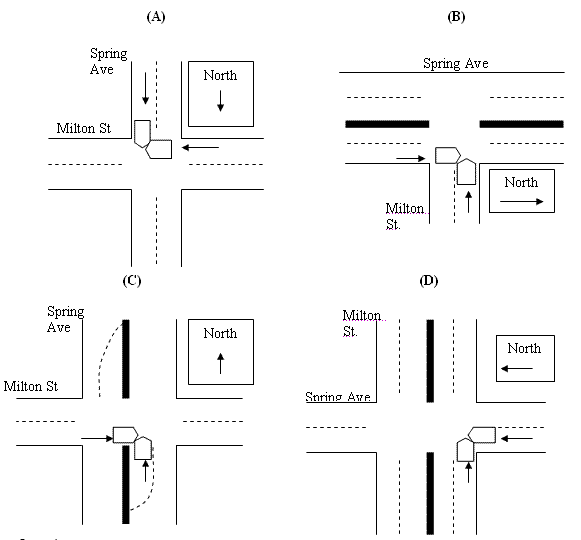
ANS: B – Option A is inaccurate as the vehicle on Spring Avenue is heading north, but the vehicle on Milton Street is heading east. Option C is incorrect because the vehicle on Spring Avenue is heading north, but the vehicle on Milton Street is heading east. Option D is also incorrect as the vehicle on Spring Avenue is heading north, but the vehicle on Milton Street is heading east as well. Option B is the only correct answer. |
|
 |
|
Question 20 |
|
|
|
 |
|
Question 21 |
|
|
|
 |
|
Question 22 |
|
|
|
 |
|
Question 23 |
|
|
|
 |
|
Question 24 |
|
|
|
 |
|
Question 25 |
|
|
|
 |
|
Question 26 |
|
|
|
 |
|
Question 27 |
|
|
|
 |
|
Question 28 |
|
The boys left first, before they were noticed and police were called. Police investigated and then acted on their investigation with an arrest. |
|
|
|
Question 29 |
|
Bill - Witness |
|
|
|
Question 30 |
|
Bill - Witness |
|
|
|
|
